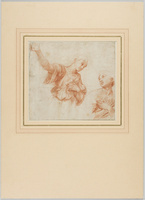
Studie voor twee engelfiguren
-
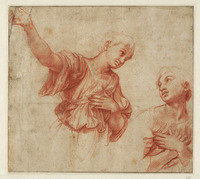
<div><p>Met zijn verfijnde stijl is Rafaël eeuwenlang hét voorbeeld van kunstenaars in West-Europa. Deze tekening van de Italiaanse meester laat zien waarom. Hij wekt twee figuren tot leven door hun elegante houdingen en bovenal hun blik, die vol emotie is. Sommige delen tekent hij in detail, zoals het gewaad van de linker figuur. Met ragfijne arceringen maakt hij schaduwpartijen, waardoor de plooien echt diepte krijgen. Andere delen van de tekening zijn juist nauwelijks uitgewerkt. Rafaël is een meester van de suggestie: zo bestaat het haar van de figuren uit enkele rake krijtstrepen. </p></div><div><p> </p></div><div><p>Rafaël maakte zijn tekeningen vaak als voorstudie voor fresco’s, muurschilderingen, en schilderijen op paneel of doek. Van dit exemplaar, uit de laatste jaren van zijn leven, is het doel is niet helder. Misschien is het een voorstudie voor het schilderij met de Heilige Familie, dat nu in het Louvre is. Eén van de engelen op de achtergrond lijkt veel op de rechterfiguur. </p></div><div><p lang="NL-NL"> </p></div><div><p lang="NL-NL">Naast deze tekening bezit Teylers Museum nog 11 andere tekeningen van Rafaël. Deze topstukken werden in 1790 in Rome aangekocht, zodat ook kunstenaars en kunstliefhebbers in Nederland geïnspireerd konden raken door de Italiaanse meester.</p></div>
[Raphael]
235
Two adolescents at half length
Red chalk on medium tan paper. Framing line in pencil. Lefthand corners damaged. Small losses at left edge and lower right (made up); old crease at top left.
202 x 224 mm.
CHAIN LINES: 36-43 mm (v).
PROVENANCE: Odescalchi; acquired in 1790 (L. 2392).
Inv. 1854: ? A 18 (Raphael, `een Studiebeeld, met Rood aard'); inv. 1864: A 69.
INV. NO.: A 68.
EXHIBITIONS: Amsterdam, 1934, no. 630; Paris-Rotterdam-Haarlem, 1962, no. 69 (repr.); London, 1970, no. 78 (repr.); Haarlem, 1978, no. 11 (repr.); Florence-Rome, 1983-1984, no. 51 (repr.); Haarlem, 1985, no. 12 (repr.).
BIBLIOGRAPHY: Ruland, 1876, p. 34, no. III, 1; Jaffé, 1962, p. 233; Shearman, 1964, p. 95, note 153; Dussler, 1966, p. 108; Van Regteren Altena, 1966, p. 52; Dussler, 1971, p. 98; Siblík, 1974, pl. 56; Schwarzenberg, 1977, p. 125, note 54; Knab, Mitsch and Oberhuber, 1983, p. 612, no. 554 (repr.); Joannides, 1983, no. 421 (repr.); Meijer, 1984, pl. 14; Harprath, 1985, pp. 414-415; Joannides, 1993, p. 23.
The comparative neglect this drawing suffered in the literature until the 1960s was doubtless due at least in part to uncertainty as to its purpose. It is almost unique among Raphael's later Roman drawings in that it has no connection to a known painted composition - at least none that is immediately evident. But given what we know about the artist's working procedures during this period, he would hardly have made such a beautifully detailed study without a definite project in mind.
The figures have been interpreted as studies for an Annunciation (Ruland, Van Regteren Altena, Schwarzenberg, Oberhuber, Joannides), but no such work is known from the artist's Roman period, in either drawings or written sources.[1] For the righthand figure, Van Regteren Altena also proposed a connection with the Psyche Loggia, as its pose resembles that of the kneeling Psyche in a drawing in the Louvre (inv. 3875; Cordellier and Py, 1992, no. 548). More plausible is the hypothesis, first advanced again by Van Regteren Altena in 1934 and reiterated by Shearman in 1964, that both figures in No. 235 were intended for the angels in the Holy Family of Francis I in the Louvre. Except for the inclination of its head, the figure on the right is virtually identical to the kneeling angel in the centre of that picture, and its right shoulder is left unfinished precisely at the point where it is overlapped in the altarpiece by the figure of Saint Anne. The standing angel differs considerably from its painted counterpart, however, and there is no demonstrable connection. In the painting, Raphael re-used a study he had made for the Wedding of Cupid and Psyche in the Farnesina (Joannides, 1983, no. 407).
Even if no link can be established conclusively, the drawing certainly dates from about the same period as the Holy Family of Francis I. That painting was commissioned by Leo X as a gift for the Queen of France and was painted in March and April of 1518 (Golzio, 1971, pp. 66-68). Although the execution was entrusted in part to the workshop, there is no doubt that Raphael was responsible for the overall design. Aside from No. 235, three red chalk studies for the painting have been identified, all of them showing aspects of Raphael's late draughtmanship. The rapid study in the Louvre for the Virgin (inv. 3862; Cordellier and Py, 1992, no. 875) was done from the model; often attributed in the past to Giulio, most authors now agree it is by Raphael himself (see Joannides, 1993, p. 23). The Madonna's drapery is examined in a magnificent hard-edged study in the Uffizi (inv. 535 E), whilst the same printroom also possesses a more fluid sketch for the Child (inv. 534 E). Taken together, the four drawings for the Holy Family of Francis I display an unequalled brilliance and variety in the handling of red chalk.
NOTE
[1] Save a late and highly dubious mention of a painting sent from Rome to Florence in 1583 (Golzio, 1971, p. 169), to which Van Regteren Altena and Lugt referred (exh. Paris-Rotterdam-Haarlem 1962).


Object numberA 068
TitleStudie voor twee engelfiguren
CreatorRaffaello Sanzio (1483-1520) (tekenaar)
Production dateca. 1517 - ca. 1518
Date (free text)ongedateerd
Subjectengel
Object namerood krijttekening
Object categorytekening
Materialpapier
Techniquegriffel, rood krijt, potlood
Dimensions
- papier hoogte: 203 mm
papier breedte: 224 mm
opzet hoogte: 510 mm
opzet breedte: 370 mm
Credit lineTeylers Museum, aangekocht van de Odescalchi erfgenamen te Rome, 1790
Documentation
Inscription creator/content
Rafael
Sassoferrato
A 95?
Teyler