
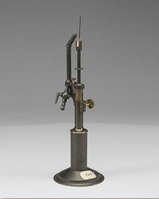
Kalklichtlamp, naar Drummond
-
Kalklicht is een soort felle belichting die in het midden van de 19e eeuw veelvuldig werd gebruikt voor theaters, concerten en toverlantaarns. Het kalklichteffect ontstaat wanneer een stuk kalksteen of leem witheet wordt verhit met behulp van knalgas (een mengsel van waterstofgas en zuurstof). Doordat knalgas in de juiste verhoudingen tot waterdamp verbrandt kan de vlam erg heet (circa 2400 °C) worden. In 1825 woonde de Schotse ingenieur Thomas Drummond (1797–1840) een demonstratie bij van het zojuist ontdekte effect. Hij ontwierp daarop een lamp die op het kalklichteffect berust. Na de uitvinding van de koolspitslamp, en later van het elektrisch licht, is de kalklichtlamp in onbruik geraakt. Dit exemplaar is gemaakt door de Franse instrumentmaker Jules Duboscq (1817-1886).
Limelight is a bright illumination often used in theatres, concerts and magic lanterns in the middle of the 19th century. The limelight effect is created when a piece of limestone or loam is heated white-hot by fulminating gas (a mixture of hydrogen gas and oxygen). As oxyhydrogen in the right proportion burns to water vapour, the flame can become very hot (about 2400 °C). In 1825 the Scottish engineer Thomas Drummond (1797–1840) attended a demonstration of the effect just discovered. Afterwards he designed a lamp based on the limelight effect. After the invention of the carbon lamp, and later on the electric light, the limelight lamp became obsolete. This specimen was made by the French instrument maker Jules Duboscq (1817-1886).
Object numberFK 0216
TitleKalklichtlamp, naar Drummond
Creator Louis Jules Duboscq-Soleil
DescriptionKalklichtlamp, naar Drummond
Production placeParijs
Production date1882
Object namekalklichtlamp
Object categorylamp
CollectionArc lamps; light
MaterialMessing