
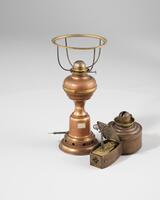
Olielamp met luchttoevoer
-
Olielamp met luchttoevoer, (214, 215)
Olielampen zijn al sinds de prehistorie bekend. Als brandstof gebruikte men lange tijd plantaardige olie of dierlijke vetten. Halverwege de negentiende eeuw ontdekte men petroleum als brandstof. Het voordeel van petroleum is dat de aanvoer van deze vloeistof naar de brander van de lamp beter verloopt dan bij olie.
Het verbranden petroleum heeft echter ook nadelen. Zo heeft petroleum meer zuurstof nodig dan olie om optimaal te verbranden, en dus maximaal licht af te geven. Daarnaast ontstaan er al bij lage temperaturen brandbare gassen die kunnen zorgen voor ontploffingen.
Om deze problemen op te lossen werden speciale lampen ontwikkeld. Hierbij werd niet alleen extra lucht naar de pit gevoerd, maar ook lucht rondom de lamp aangezogen om deze te koelen.
De luchttoevoer in de hier getoonde petroleumlampen wordt geregeld met behulp van een uurwerk, dat kan worden opgewonden met de bijbehorende sleutel.
Oil lamps have been known since prehistory. For a long time, vegetable oil or animal fat was used as fuel. In the middle of the nineteenth century, paraffin was discovered as fuel. The advantage of paraffin is that the flow of this fluid to the burner of the lamp is smoother than with oil. However, burning paraffin has also disadvantages. Paraffin needs more oxygen than oil to burn optimally, and thus to give maximum light. Furthermore, even at low temperatures, flammable gases are formed which may cause explosions. To solve these problems, special lamps were developed. In these lamps, extra air was led not only to the wick, but also around the lamp to cool it. The air inlet in the paraffin lamps shown here, is regulated by a clockwork, which can be wound up with the corresponding key.
Object numberFK 0215
TitleOlielamp met luchttoevoer
DescriptionOlielamp met luchttoevoer
Production date 1876
Object nameolielamp
Object categorylamp
CollectionMiscellaneous; Heat