
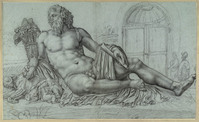
De Tiber
-
100
The River God Tiber
Verso: Motifs from the Frieze on the Back
of the Pedestal
Inv. no. K III 025
Black and white chalk on grey-blue paper; framing lines in
pencil (partly trimmed)
Verso: sketches in black chalk (crosswise)
326 x 533 mm; top and bottom edges slightly trimmed, vertical
fold in the middle, strengthened on the verso
Watermark: bird in a circle (cf. Briquet nos. 12210 [1591,
Syracuse] and 12232 [1589, Rome])
Verso, at bottom left the mark of Teylers Foundation
(Lugt 2392)
Provenance: see cat. no. 84
Exhibition: New York/Chicago 1989, no. 62
Literature: Reznicek 1961, p. 91 and no. 204; Miedema 1969,
pp. 76-77; Brummer 1970, pp. 194-195 and 212; Kemp/Smart
1980, p. 185; Veldman 1988, p. 168; Stolzenburg 2000, no. 177 or
178; Brandt 2001, pp. 137 and 148; Amsterdam etc. 2003, p. 119;
Bober/Rubinstein 2010, under no. 66; Nichols 2013, p. 56 and
under no. A-2
The marble Tiber, more than 3 metres wide, was excavated near
S. Maria sopra Minerva in 1512. Pope Julius II bought it and
erected it beside a fountain in the middle of the statue court
of the Belvedere, facing the river god Nile. That arrangement
is illustrated in a drawing by Maarten van Heemskerck in the
British Museum in London (see fig. 101a). The god is identified
as the Tiber by the damaged group of the she-wolf suckling
Romulus and Remus at bottom left. The river god’s traditional
attribute of the cornucopia symbolises the prosperity that a
country owes to a river. Part of the oar in Tiber’s left hand had
broken off in Goltzius’s day, and was only replaced in the eighteenth
century, along with a big toe, the wolf ’s muzzle and the
leg of one of the children. The statue has been in the Louvre
since 1797 as part of the booty looted by Napoleon that was
never restituted (Haskell/Penny 1982, no. 79; Bober/Rubinstein
2010, no. 66).
Tiber, like Nile (cat. no. 101), is on a very wide sheet of paper.
Goltzius first made a rapid sketch which he then worked
up with stumped and heightened passages that give the marble
body a convincing plasticity. He also rendered details with the
utmost precision, like the two joins in the left leg resulting from
the restoration of 1524-25. This is a more faithful record of the
statue than Baldassare Peruzzi’s in his drawing of half a century
earlier that is now in the British Museum, in which he filled
in the missing sections from his imagination (Amsterdam etc.
2003, p. 119 and fig. 48). In the background Goltzius included
the door of the niche in the north wall of the statue court behind
which Hermes of Andros, also known as Antinous (cat. no. 107),
stood in his day. To the right is a jotting of two visitors, while
a few strokes to the left indicate water plants in the fountain.
Crosswise on the back of the sheet Goltzius drew motifs from
the frieze on the back of Tiber’s pedestal: boats, small figures on
and around the river, and a few animals. The abrupt truncation
of those sketches shows that the sheet was cut down a little at
top and bottom, as seen from Tiber.
The drawing is not indented, and given the detailed treatment
no red chalk version would have been made. Goltzius later used
the statue’s pose for the figure of Adam in his 1616 Fall of Man in
Washington’s National Gallery (Nichols 2013, no. A-2). • imv

Object numberK III 025
TitleDe Tiber
Creator Hendrick Goltzius (1558-1617) (tekenaar)
DescriptionSculptuur van riviergod Tiber.
Production placeRome
Production date 1590 - 1591
Subjectcornucopia, hoorn des overvloeds, sculptuur, Tiber (rivier), riviergod, dier: wolvin, Romulus en Remus, stuurriem, topografie (I): Rome: Vaticaan: Belvedere, topografie (F): Parijs: Musée du Louvre
Object nametekening
Materialpapier, blauw
Dimensions
- hoogte: 325 mm
breedte: 537 mm
opzet hoogte: 461 mm
opzet breedte: 636 mm
Credit lineTeylers Museum, aangekocht van de Odescalchi erfgenamen te Rome, 1790
Documentation
Related object
Inscription creator/content
Teyler