
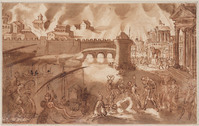
Aeneas en zijn gezin verlaten het brandende Troje
Object numberK II 091
TitleAeneas en zijn gezin verlaten het brandende Troje
Creatoranoniem NL (17de eeuw) (tekenaar)
Descriptionverso: schets van een staand naakt.
Label249
Southern Netherlands, c. 1600
Aeneas and his Family Fleeing from Burning Troy
Verso: Sketch of a Standing Male Nude
Inv. no. K II 091
Pen and brown ink over a sketch in red chalk, brush in
brown, on the right edge remains of framing lines in black
chalk or pencil
Verso: black chalk, pen and brown ink (the man’s head)
209 x 337 mm; several damaged areas, vertical fold in the
middle
Verso, at bottom left the mark of Teylers Foundation (Lugt
2392) and left of centre an illegible inscription in four lines (pen
and brown ink, in an old hand)
Provenance: Queen Christina of Sweden (1626-1689),
Stockholm and Rome; Cardinal Decio Azzolini (1623-1689),
Rome; Marchese Pompeo Azzolini (1654-1706), Rome; sold
to Don Livio Odescalchi (1652-1713) in 1692, Rome; heirs of
Odescalchi, Rome; acquired in 1790 by Teylers Foundation
Literature: Van Tuyll van Serooskerken 2000, p. 516
(as Flemish 17th. c.?)
In the right foreground Aeneas has hoisted his father Anchises
onto his back and is fleeing the inferno of Troy accompanied
by his young son Ascanius and his wife Creusa (Aeneid 2:671-
729). Greek and Trojan soldiers in the right background are
fighting around the wooden horse in which the Greeks managed
to slip into the city undetected (Aeneid 2:237-269).
The scene was inventoried as ‘La presa di Troia’ in an album
of Italian drawings belonging to Queen Christina (Libro I:2,
c. 121, see Van Tuyll van Serooskerken 2000, p. 516). Antonio
Tempesta is proposed as the draughtsman in an anonymous
annotation on the passe-partout, but it is more likely to have
been a Flemish artist. That is because the structure of the composition,
with the burning city and a bridge in the background,
the Trojan horse on the right and the embarkation of Aeneas
and his family in the foreground, was unmistakably inspired
by Jan Brueghel the Elder, who painted an Aeneas and Anchises
Fleeing Troy, of which there are several known copies (Ertz/
Nitze-Ertz 2008-10, II, no. 325 and nos. 326-328). It is also the
subject of two drawings by Lodewijk Toeput: The Destruction
of Troy, with the Flight of Aeneas in the Foreground in the P. &
N. de Boer Foundation in Amsterdam and The Fire of Troy in
the Nationalmuseum in Stockholm (Stockholm 1953, no. 50). It
is true that the Haarlem sheet is not as clearly designed as the
works by Brueghel and Toeput, and the perspective is less successful,
but the similarities in subject and composition confirm
that it is by a Flemish master.
On the back of the sheet there is a rapid sketch of a standing
nude man seen from below with a lance or spear in his left
hand, with only the head being worked up with pen and brown
ink. • yb
Production dateca. 1600
Date (free text)ongedateerd
Subjecticonografie: mythologie, Troje (Oorlog van -), Paard van Troje, houten paard, Aeneas, Anchises, Ascanius, brand, plundering, literatuur (Vergilius: Aeneas)
Object nametekeningen
Materialpapier
Techniquerood krijt, pen in bruin, penseel in bruin, potlood
Dimensions
- hoogte: 209 mm
breedte: 336 mm
opzet hoogte: 390 mm
opzet breedte: 507 mm
Credit lineTeylers Museum, aangekocht van de Odescalchi erfgenamen te Rome, 1790
Related object
Inscription creator/content
Teyler